7 Simple Habits to Reduce Morning Stress Before Checking Your Phone
Discover 7 simple morning cortisol reduction strategies to manage stress, improve focus and support mental wellbeing before checking your phone.
By The Mindbriz Team
Why Your Morning Routine Matters More Than You Think
Do you wake up, reach for your phone and immediately start checking emails, social media or the news? Before your feet even touch the floor, your mind may already be racing through your responsibilities for the day.
This habit can make mornings feel more stressful than they need to be.
Your body naturally experiences hormonal changes after waking, including a rise in cortisol, a hormone that helps regulate alertness, metabolism and the body's response to stress. When this natural waking process coincides with notifications, work demands and upsetting headlines, your morning may feel overwhelming.
The good news? You do not need an expensive wellness product or a complicated morning routine to get started. Small changes, such as breathing slowly, getting natural daylight and delaying your first phone check, can help you create a calmer start to the day.
In this guide, we explore seven practical morning cortisol reduction strategies that can support stress management, focus and everyday mental wellbeing.
What Is the Cortisol Awakening Response?
Cortisol is often called the stress hormone, but it is also essential for normal bodily functions. It helps regulate energy, blood pressure, metabolism and your sleep-wake cycle.
Many people experience a natural increase in cortisol during the first 30–45 minutes after waking. This is known as the cortisol awakening response (CAR).
The response varies between individuals and can be influenced by sleep, circadian rhythms, stress and other factors.
Importantly, a morning rise in cortisol is not automatically unhealthy. It is part of your body's normal biological rhythm.
The goal is not to eliminate cortisol or force your body to keep its levels as low as possible. Instead, focus on managing avoidable stressors and building habits that help you feel more settled, alert and prepared for the day.
How Checking Your Phone First Thing Can Increase Morning Stress
Smartphones make it easy to move directly from sleep into the demands of everyday life.
An unread work email, a financial worry, a distressing news story or a comparison with someone else's social media post can immediately occupy your attention.
For some people, this creates a pattern of mental overload before the day has properly begun.
Checking your phone does not automatically cause a cortisol spike, and the effects differ from person to person. However, emotionally demanding content and constant notifications can contribute to feelings of tension, distraction and anxiety.
Starting the day with a few minutes away from your screen gives you an opportunity to notice how you feel before responding to external demands.
7 Morning Cortisol Reduction Strategies to Try Before Checking Your Phone
1. Practise Slow, Gentle Breathing
Before reaching for your smartphone, take two to five minutes to focus on your breathing.
Try this simple exercise:
Breathe in gently through your nose for four seconds.
Breathe out slowly for six seconds.
Repeat for one to two minutes, adjusting the timing to remain comfortable.
Keep your shoulders relaxed and avoid forcing deep breaths.
Slow breathing may help support relaxation and reduce feelings of tension. If you feel dizzy or uncomfortable, return to your normal breathing pattern.
You can also try box breathing, using equal periods of inhalation, holding, exhalation and holding. Choose whichever technique feels most comfortable.
MindBriz tip: Make breathing part of your morning routine by pairing it with a familiar activity, such as sitting on the edge of your bed or opening your curtains.
2. Get Natural Daylight in the Morning
Light plays an important role in regulating your circadian rhythm, the internal clock that helps coordinate sleep and wakefulness.
Getting outside for natural daylight after waking can support your body's day-night timing and help you feel more alert.
Try stepping outside for a short walk, spending a few minutes in your garden or sitting near a bright window while getting ready.
Outdoor daylight is generally more effective than ordinary indoor lighting, although the ideal duration depends on the season, weather and individual circumstances.
Never look directly at the sun. In the UK, where winter mornings can be particularly dark, consistency matters even when bright sunlight is unavailable.
3. Drink Water Before Your First Coffee
After several hours of sleep, drinking some water is a simple way to replenish fluids.
Keep a glass of water beside your bed or in the kitchen so that hydration becomes an easy first step in your routine.
Coffee does not need to be eliminated to have a healthy morning. Caffeine can improve alertness, but it can also increase feelings of nervousness, palpitations or restlessness in sensitive individuals.
If you regularly wake up feeling anxious, consider how much caffeine you consume and whether your first coffee makes you feel calmer or more jittery.
Hydration supports general health, but drinking water has not been established as a direct method of lowering morning cortisol.
4. Delay Notifications and Social Media
One of the simplest ways to create a calmer morning is to introduce a short screen-free period.
Start with just 10 minutes. If that feels manageable, gradually extend it to 20 or 30 minutes.
During this time, avoid checking:
Work emails and messages.
Social media notifications.
Breaking news and distressing headlines.
Tasks and reminders that can wait until later.
You do not need to disconnect from technology completely. The aim is to decide when you engage with your phone rather than allowing notifications to dictate your first thoughts.
Try this: Put your phone on Do Not Disturb overnight and keep it outside arm's reach. If you use your phone as an alarm, prepare your morning settings before going to sleep.
5. Make Time for Gentle Movement
Movement can help you transition from sleep to wakefulness and support your overall physical and mental wellbeing.
You do not need an intense workout to benefit from starting your day actively.
Try one of these options:
Take a five- to ten-minute walk.
Stretch your back, shoulders and legs.
Practise gentle yoga.
Move around your home while preparing breakfast.
Choose an activity that feels achievable, even on busy mornings.
Exercise can influence cortisol in different ways depending on its intensity, duration and timing. Therefore, it is better to focus on finding a sustainable movement routine than trying to achieve a specific cortisol level.
6. Reduce Decision Fatigue with a Predictable Routine
Mornings can feel chaotic when every decision has to be made from scratch.
What should you wear? What should you eat? What needs to be completed first? Have you forgotten an appointment?
Preparing a few things the night before can reduce unnecessary mental effort in the morning.
For example:
Choose your clothes before going to bed.
Prepare your breakfast or lunch.
Write down your three main priorities for the next day.
Set a consistent time to wake up.
Leave essential items in a designated place.
A predictable routine creates fewer opportunities for last-minute rushing and makes healthy habits easier to repeat.
Remember that routines should support you, not become another source of pressure. Allow some flexibility for difficult or unpredictable days.
7. Check In with Your Mood Before Starting the Day
Before opening your inbox, pause and ask yourself three simple questions:
How am I feeling right now?
What might be contributing to that feeling?
What is one small thing I can do to support myself today?
You might feel refreshed, worried, tired, hopeful or somewhere in between. There is no need to judge the answer or force yourself to feel positive.
A brief mood check-in can help you become more aware of recurring patterns, such as feeling more tense after poor sleep or becoming overwhelmed when you start the day with work messages.
You could record your mood in a journal or use a wellbeing app to track patterns over time.
MindBriz tip: MindBriz is designed to support everyday wellbeing through features such as mood tracking, guided relaxation and reflective check-ins. These tools can help you build awareness of your habits and feelings without treating every difficult morning as a medical problem.
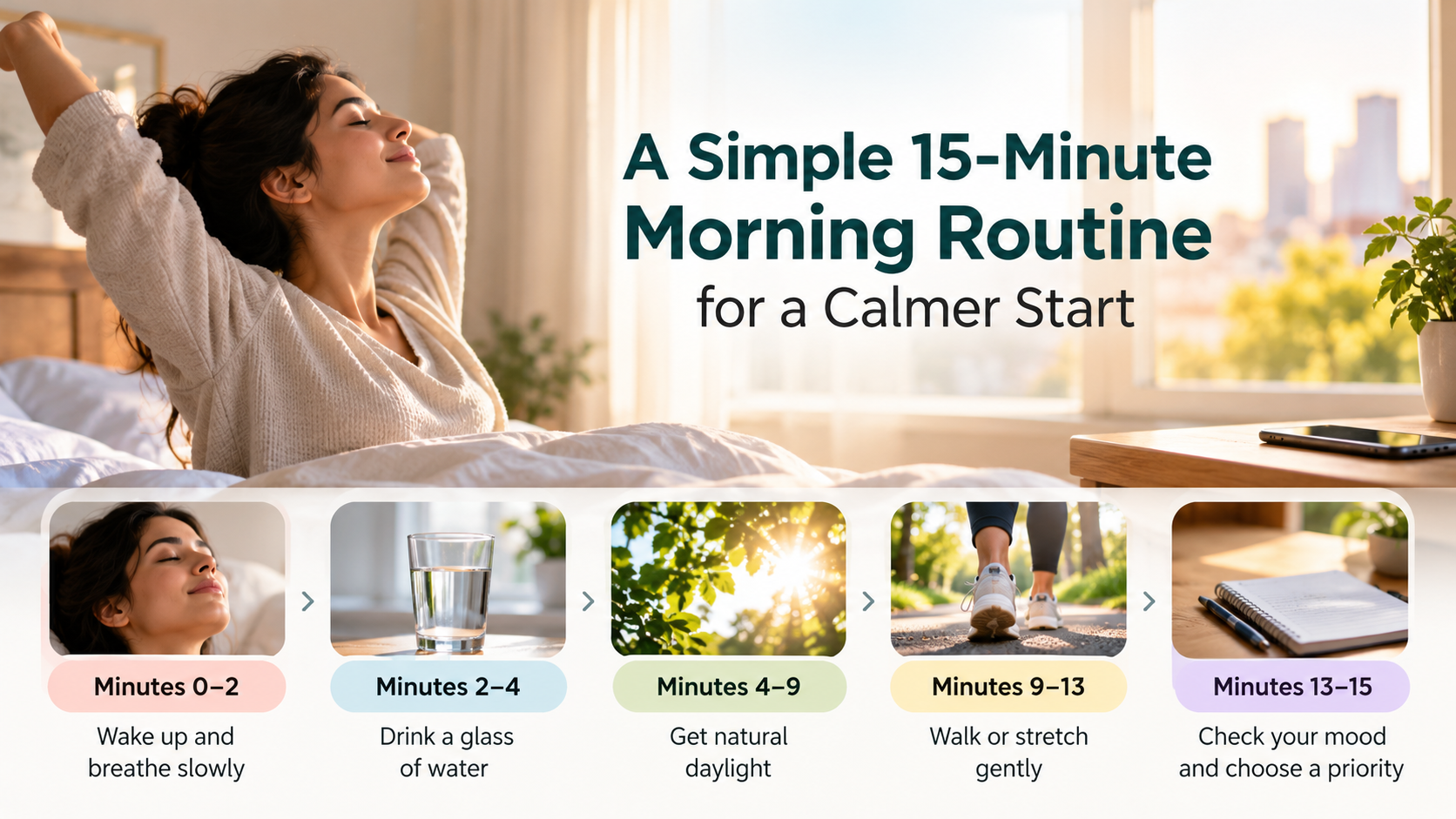
A Simple 15-Minute Morning Routine for a Calmer Start
You do not need to follow all seven strategies every morning. Begin with a short routine that fits your lifestyle.
Start your day with just 15 minutes dedicated to yourself. Before checking your phone, take a moment to breathe slowly, hydrate with a glass of water, and enjoy some natural daylight. Spend a few minutes walking or stretching gently to awaken your body. Finally, check in with your mood, identify how you are feeling, and choose one priority for the day. These small, intentional habits can help you feel more refreshed, focused and prepared to manage daily challenges.
Your 15-minute morning reset:
0–2 minutes: Wake up and practise slow breathing.
2–4 minutes: Drink a glass of water.
4–9 minutes: Get natural daylight.
9–13 minutes: Enjoy a gentle walk or stretch.
13–15 minutes: Check your mood and set one daily priority.
Keep your phone out of reach until the routine is complete, if practical.
On particularly busy days, even two minutes of slow breathing and a brief pause before checking notifications can be a useful starting point.
How to Track Your Morning Stress and Wellbeing
Changing your routine is easier when you understand which habits work for you.
Instead of trying to measure or control cortisol directly, pay attention to everyday indicators of wellbeing.
For one or two weeks, record:
Sleep: How rested do you feel when you wake up?
Mood: What words best describe your morning?
Stress: How tense or overwhelmed do you feel?
Screen time: How soon did you check your phone?
Daily habits: Did you practise breathing, get daylight or move?
Focus: How easy was it to begin your first important task?
Look for patterns rather than expecting immediate results. You may discover that getting enough sleep matters more than delaying coffee, or that checking work messages early is a particular source of stress.
These observations can help you adapt your routine to your real life.
Remember that mood tracking is a self-reflection tool, not a cortisol test or a diagnostic assessment.
Common Myths About Morning Cortisol
Myth 1: Cortisol is always bad.
Cortisol is essential for normal bodily functions. A natural morning rise helps prepare your body for the day.
Myth 2: Checking your phone always causes a cortisol spike.
The effect of phone use varies. Emotionally stressful content and notifications may increase perceived stress, but a specific hormonal response cannot be assumed.
Myth 3: Drinking water immediately lowers cortisol.
Hydration supports normal bodily function, but there is insufficient evidence to claim that drinking water directly lowers morning cortisol in healthy people.
Myth 4: You must complete a perfect morning routine to feel better.
Consistency and practicality matter more than perfection. Start with one or two habits and adjust them as needed.
When Should You Seek Help for Morning Anxiety?
Occasional worry or a racing mind in the morning does not necessarily indicate a health condition.
However, if anxiety is persistent, interferes with sleep or daily activities, or becomes difficult to manage, consider speaking with your GP or another qualified healthcare professional.
Seek appropriate medical advice if you experience ongoing palpitations, significant sleep problems or other unexplained physical symptoms. Do not assume that these symptoms are caused by cortisol alone.
If you have concerns about an underlying hormonal problem, a healthcare professional can assess your symptoms and determine whether testing is appropriate.
Final Thoughts: Give Yourself the First Few Minutes of the Day
Your morning does not have to begin with someone else's priorities.
Before the emails, notifications and headlines, give yourself a little space to wake up, breathe, move and notice how you feel.
You do not need to eliminate stress or control every aspect of your biology. Small, repeatable habits can help you approach the day with greater awareness and a more intentional mindset.
Start tomorrow with one simple change: wait 10 minutes before checking your phone.
Use that time to drink water, get some daylight or practise slow breathing. Notice how you feel and build from there.
A calmer morning is not about achieving perfection. It is about creating a healthier relationship with your time, attention and everyday wellbeing.
Ready to make wellbeing part of your daily routine? Explore MindBriz for tools that support mood awareness, guided relaxation and everyday self-care.
Visit: https://mindbriz.com/
Frequently Asked Questions (FAQs)
1. How can I reduce morning cortisol naturally?
Focus on healthy daily habits, including consistent sleep, morning daylight, gentle movement, relaxation techniques and managing stress. These habits support general wellbeing and healthy circadian rhythms, but they do not guarantee a reduction in cortisol levels.
2. Does checking your phone first thing in the morning increase cortisol?
Phone use does not automatically cause a cortisol spike. However, stressful emails, negative news and constant notifications can increase perceived stress and make some people feel anxious or overwhelmed.
3. What is the cortisol awakening response?
The cortisol awakening response is the natural rise in cortisol that many people experience during approximately the first 30–45 minutes after waking. It is part of the body's normal transition from sleep to wakefulness.
4. Is morning anxiety a sign of high cortisol?
Not necessarily. Morning anxiety can have many contributing factors, including poor sleep, everyday stress, caffeine sensitivity and anxiety-related conditions. Symptoms alone cannot establish whether cortisol is elevated.
5. Should I drink water or coffee first in the morning?
Drinking water first is a simple way to support hydration after sleep. Coffee can still be part of a healthy routine, but people who experience jitteriness or anxiety may benefit from adjusting their caffeine intake.
6. How long should I wait before checking my phone?
There is no scientifically established ideal waiting period. Start with 5–10 minutes and extend it if helpful. The aim is to create a manageable pause, not to follow a rigid rule.
7. Can breathing exercises help with morning stress?
Slow, comfortable breathing may support relaxation and help some people manage feelings of stress. It is a useful self-care practice, although it should not be presented as a guaranteed way to lower cortisol.
Disclaimer: This article is for general educational and wellbeing purposes only. It does not provide medical advice, diagnose anxiety or hormonal conditions, or replace care from a qualified healthcare professional.